
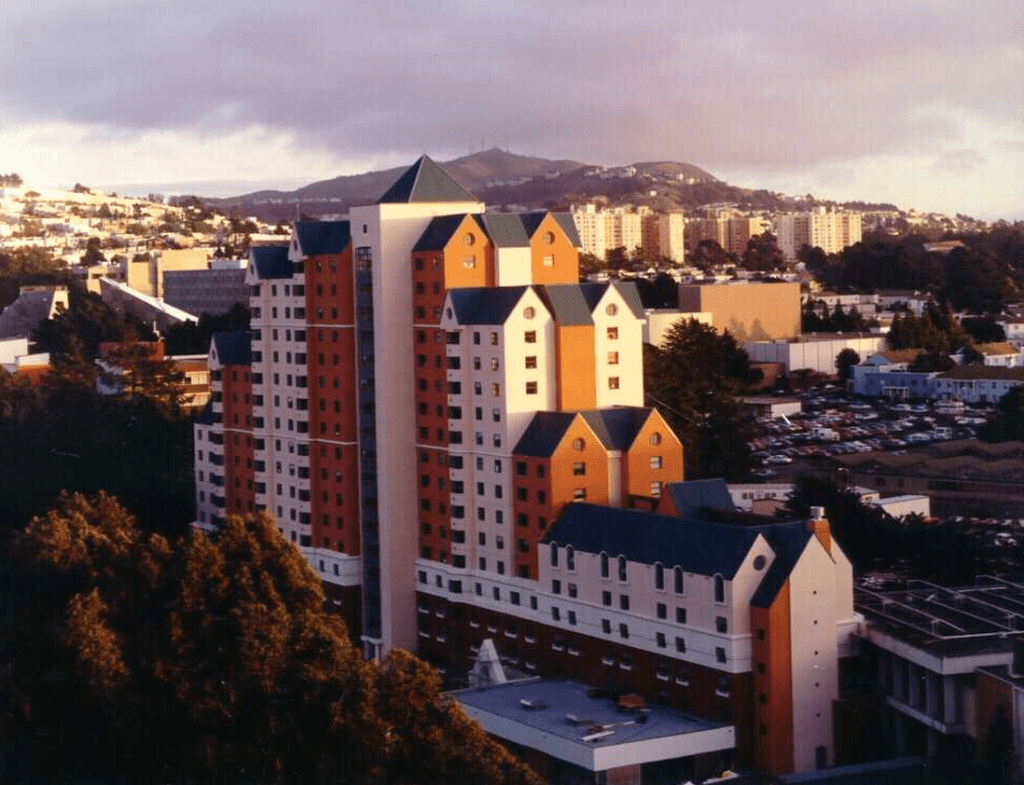
San Francisco, CA
Status: Completed in late 1990
| Owner | California State University System |
| General Contractor | Perini Corporation |
| Reinforcing Steel Sub-Contractor | JL Davidson |
| Reinforcing Engineer | Baumann Engineering |
| Architect | Bodrell Joer’dan Smith, AIA |
| BauGrid Manufacturer & Supplier | MedoMesh |

17- Story student dormitory on campus at SFSU was built in 1989. Special tests at the University of California, Irvine, indicated that BauGrid could increase the ductility of the structure, reducing the design seismic forces. This allowed a redesign of the building which reduced the thickness of the
shear walls by 30%, from 10” to 7″. This significantly reduced the material costs, equipment, and labor.
When the building was about 90% complete, at about the 14th floor, the 7.0 magnitude Loma Prieta Earthquake struck the San Francisco Bay Area in October 1989. Despite its proximity to the San Andreas Fault (approx. 1.5 miles), upon inspection, no evidence of earth quake damage, not even hairline cracks often associated with new concrete were discovered.
Read the Full Story
17- Story student dormitory on campus at SFSU was built in 1989. Baumann Engineering was brought into the project in 1987. At that time, Baumann Engineering proposed the use of a product called (at that time) MedoMesh, which was a product he had invented and was working to develop with a company called Meadow Steel.
Agreement was reached to perform tests at the University of California , Irvine, which showed that using the new reinforcement product, the ductility of the building was increased, and so the earthquake forces the building must be designed to withstand could be calculated at a lower level. This allowed a redesign of the building which reduced 10″ thick shearwalls to 7″ thick shearwalls, dramatically reducing the client’s costs of materials (concrete, rebar, lap steel), equipment (crane time was reduced) and labor (manual assembly drastically reduced labor.
The UC Board of Regents at the time included several engineers, and it was agreed that the Board would review the proposed design, which it did, and then approved it. When the building was about 90% complete (at about the 14th story, however most of the square footage is below the 14th floor) the Loma Prieta earthquake struck. Despite its proximity to the San Andreas Fault (approx. 1.5 miles), upon inspection Baumann Engineering found no evidence of earthquake damage, not even hairline cracks often associated with new concrete
 BauGrid® Reinforcement